Are Smart Water Leak Detectors Worth It? What They Catch and What They Miss
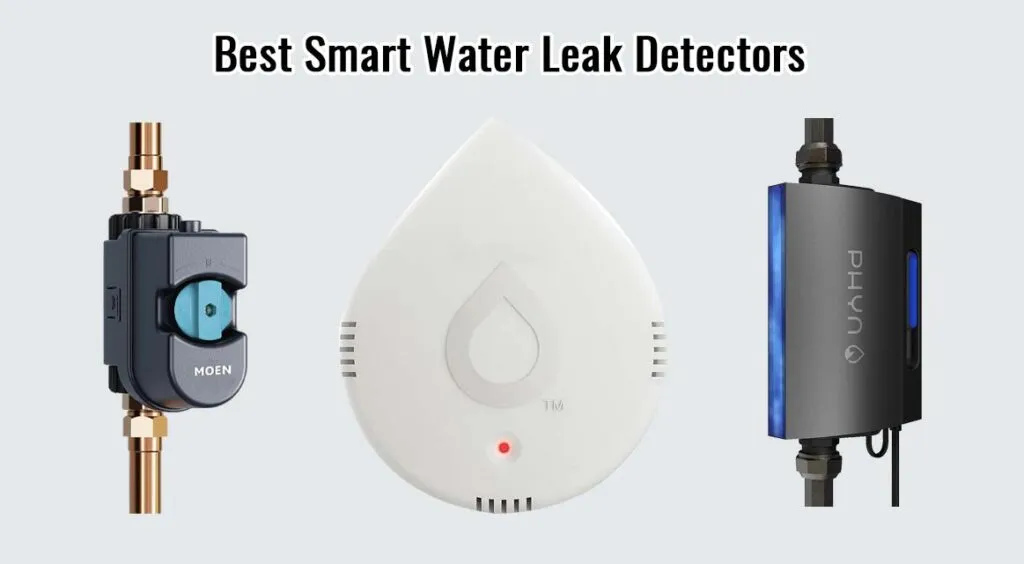
The honest answer depends on what you are protecting against. For a leak that starts while the house is empty, these devices are among the few things that genuinely help. For finding a leak that has already started, they do almost nothing.
What the devices actually do, and what they are
Smart leak detection is three quite different product categories sold under one phrase, and most disappointment comes from buying one and expecting the behaviour of another. The distinction that matters is whether a device detects water that has already escaped, or detects the flow that is escaping, and whether it can do anything about it.
| Type | How it detects | What it does | What it will not catch |
|---|---|---|---|
| Spot sensors, sometimes called pucks | Contacts bridged by water on the floor | Alerts your phone, sometimes sounds locally | Anything leaking where you did not place one |
| Cable or rope sensors | Water anywhere along a run of sensing cable | Alerts, and covers a line rather than a point | Leaks above the cable, inside walls or in voids |
| Flow monitors on the incoming main | Unusual flow rate, volume or duration | Alerts, and logs consumption over time | Anything not fed from the monitored supply |
| Flow monitor with automatic shut-off valve | Same, but acts on what it finds | Closes the supply automatically | Heating circuits, waste pipes, stored water below the valve |
| Acoustic or ultrasonic add-ons | Listens for the signature of escaping water | Flags a suspected loss for investigation | Non-pressurised and low flow losses |
| Smart water meter alerts from your supplier | Consumption pattern analysis at the meter | Notifies you of continuous usage | Anything downstream of a stored tank, and fast events |
Only one row of that table does anything other than tell you. A spot sensor under a washing machine is a very good alarm and a completely useless defence if you are on a plane. The device that changes outcomes is the one on the incoming main with a valve attached, because it removes the pressure that is driving the loss without anyone being present.
The case these devices genuinely solve
Consider the scenario properly, because it is the one that justifies the whole category. A flexible tap connector under a basin fails at eleven in the morning on the second day of a fortnight away. Nobody is home. The supply is on. Water runs at mains pressure into a first floor bathroom for twelve days.
That is not a plumbing problem by the time anyone returns. It is a floor structure problem, a ceiling problem, an electrics problem and, quite possibly, a neighbour's problem. The repair to the connector itself is trivial. Everything else is not, and no amount of promptness after the fact recovers it.
Against that scenario, an automatic shut-off valve is one of very few interventions that works. It notices continuous flow where there should be none, and it closes. The event still happened, but it lasted minutes instead of days. That single case is where the value of these systems is concentrated, and it is why the question is not really whether they are worth it but whether your property has that exposure.
What to do before you leave, device or no device
A monitored supply is a supplement to the free measures, not a replacement for them, and the free measures are what most claims turn on.
- Turn the stop tap off if you will be away for more than a few days and have nothing that needs a supply, which removes the pressure entirely.
- If you leave the water on, leave the heating on a frost setting through the winter rather than switching it off.
- Read the meter on the way out and again on the way in. It is a free record of exactly how much water the property used while empty.
- Replace any flexible tap connector that is more than a few years old before you go, because they fail at the crimp without warning.
- Leave a key with someone who can attend, and make sure they know where the stop tap is and how to operate it.
- Tell your insurer if the property will be empty beyond the period the schedule allows, rather than discovering the condition afterwards.
Our checklist for a leak check before going on holiday sets out the full sequence, and the wider preventive measures are covered in how to prevent water leaks at home.
Unoccupancy conditions are in your policy whether you have read them or not
Most UK home policies impose conditions once a property has been unoccupied for a stated number of consecutive days, commonly requiring that the water is turned off at the stop tap or that the heating is maintained at a minimum temperature. Exceed the period without meeting the condition and cover can be affected. The Financial Ombudsman Service has published commentary on escape of water in unoccupied properties, and the disputes turn heavily on when the leak actually began relative to that threshold.
That is the second, quieter argument for a monitored supply. A flow log is a timestamped record of exactly when the loss started, which is otherwise almost impossible to establish after the fact. It is also evidence that supports a claim rather than complicating it, and evidence quality is what our insurance leak claim reporting is organised around.
What they cannot do, stated plainly
These systems are marketed on the successes. The limitations are real and they are rarely on the box.
- They do not locate anything. A flow monitor tells you that water is leaving. It has no idea where from. You still need a survey, and the device has saved you volume, not diagnosis.
- They only see what they are plumbed into. A valve on the incoming cold main cannot stop a leak on a sealed heating circuit, a waste pipe, a stored cold tank or anything downstream of the tank.
- They depend on power and connectivity. A device that alerts by app is only as good as the broadband, the router's power supply and the battery. A power cut during a cold snap is precisely when both fail.
- They generate false positives. A long garden watering session, a filling pool, a guest running a bath, or a new appliance can all look like a leak to a flow algorithm, and a valve that closes on you repeatedly gets disabled by its owner within a month.
- They can be too slow for a fast event. Thresholds tuned to avoid nuisance shut-offs will let a large burst run for some period before acting.
- They do nothing about damage already occurring. A leak that has been running inside a wall for six months is invisible to a flow monitor that has been learning that pattern as normal.
- They are not a substitute for a working stop tap. If your manual stop tap is seized, fit a device and you now have two things that will fail in an emergency.
A motorised valve is a mechanical device and mechanical devices stick
The part of these systems that actually protects you is a motorised ball valve in the supply. Like any valve, it can seize if it never moves, and a valve that has sat open for three years may not close when asked. Good units exercise themselves periodically for exactly this reason, and it is a specific question worth asking before buying. It also means that a manual bypass, and knowing how to operate it, is not optional: a failed valve stuck closed leaves you with no water at all.
Fitting one in a UK property, and where the rules bite
Anything plumbed into the drinking water supply is subject to the Water Supply (Water Fittings) Regulations 1999, which place duties on owners and on anyone carrying out plumbing work. In practice that means fittings should be of an appropriate standard, and a WRAS approval is the straightforward way to demonstrate that a product is acceptable for contact with wholesome water. Backflow protection principles set out in BS EN 1717 apply to the installation as a whole, not just to the new component.
The physical requirements are more mundane and more often the obstacle. The valve goes on the incoming main, after the internal stop tap, somewhere accessible. It needs a power supply nearby, and in many London properties the main enters under a kitchen unit with no socket in sight. It needs enough straight pipe for the fitting, and it needs to be somewhere a future engineer can reach it without dismantling a kitchen.
Flats, leasehold consent and shared supplies
In a flat the calculation changes. The incoming supply may arrive in a communal riser cupboard rather than inside your demise, in which case fitting anything to it is not simply your decision, and the lease will usually require the freeholder's consent for alterations to the installation. Where several flats share a supply pipe, a device on the common run does not belong to any one leaseholder at all.
The workable answer in most flats is a monitor plus sensors inside the demise rather than a valve on a communal main, accepting that you get alerting rather than automatic action. It is less protection, and it is honest to say so.
What to look for, and what to ask before buying
| Feature | Why it matters | The question to ask |
|---|---|---|
| Automatic shut-off, not alerts alone | Alerts do nothing when you cannot get home | Does it close the supply by itself, or only notify me? |
| Valve self-exercising | A valve that never moves can seize open | Does it cycle itself, and how often? |
| Battery backup and offline behaviour | Power cuts and broadband outages coincide with cold snaps | What does it do when the internet or the power is lost? |
| Manual override and bypass | You need water when the device fails, not an argument with an app | How do I open the supply by hand? |
| Away mode or holiday mode | Thresholds that suit a busy house are too loose for an empty one | Can I tighten the sensitivity while I am away? |
| WRAS approved components | Demonstrates suitability for contact with drinking water | Is the product approved, and is the approval current? |
| Data export and history | A timestamped flow log is usable evidence in a claim | Can I export the history, or is it locked in the app? |
| Local alarm as well as app alert | Somebody in the house should hear it too | Does it sound on the device itself? |
One further consideration is worth weighing: these are cloud-connected products, and a company that ceases trading or retires a platform can leave a functioning valve with no app to control it. Ask what happens locally if the service disappears.
Where the sensors actually earn their place
If you are fitting spot sensors rather than a whole-supply device, placement is everything, and the useful positions are not always the obvious ones.
| Location | What it catches | Why there |
|---|---|---|
| Under the kitchen sink | Tap tails, isolating valves, waste traps, dishwasher supply | The highest concentration of fittings in most homes |
| Behind or beneath the washing machine | Failed fill hoses, which fail at the crimp without warning | A classic unattended failure, and always at pressure |
| Beside the boiler and any cylinder | Pump seals, valves, pressure relief discharge, condensate | Many small connections in a confined space |
| In the airing cupboard or tank space | Stored cold tanks, overflow and ball valve failures | Often on an upper floor, directly above living space |
| Under a bath or behind a shower panel | Waste leaks that only show while the appliance drains | The commonest cause of a collapsed ceiling below |
| At the lowest point of a basement or cellar | Supply leaks, groundwater and pump failures | Water finds the low point before it finds you |
| Beneath the incoming main where it enters | Failures at the entry point and at the stop tap gland | Often boxed in and never inspected |
Sensors do not replace the ordinary preventive measures, and the two together are far stronger than either alone. Replacing perished flexible connectors before they fail, lagging pipework in unheated voids, and knowing where every isolation point is remain the cheapest protection available, which is the subject of our guide to preventing water leaks.
So are they worth it, and for whom
For a property that is regularly empty, a second home, a flat let out between tenancies, or a house whose owners travel, a flow monitor with an automatic shut-off valve is among the few purchases that genuinely changes an outcome rather than merely informing you of it. The failure it prevents is the twelve day one, and that is the failure that costs more than everything else on this page combined.
For an occupied family home where somebody is almost always there, the honest answer is more qualified. Spot sensors in the six or seven right places are inexpensive and catch appliance failures early. A whole-supply valve is a larger intervention for a smaller marginal gain, because somebody is usually present to hear water running.
What none of them do is find a leak that is already happening, and that is the distinction to hold on to. A monitor tells you water is leaving. It cannot tell you whether the loss is a pinhole in a heating flow under a screed, a waste connection behind a bath, or a supply pipe under the drive, and those three are found by three different methods. When a device flags a loss, or when the meter is turning and nothing is running, the next step is a survey, and that is what 24 hour leak detection exists to do. The sensible arrangement is both: a device that limits the volume, and a method that finds the source.
How we help with this
If the article describes a problem you actually have, these are the visits that deal with it.
- preventing the next leak
Where pipes fail in London homes and what actually reduces the risk.
- our full guide to leak detection
How each method works and when it is the wrong tool for the job.
- leak detection in London
Finding a hidden leak without opening the property up first.
Frequently asked questions
Will a smart leak detector find a leak I already have?
No, and this is the most common misunderstanding about them. A flow monitor tells you water is leaving your supply; it has no idea where from. A spot sensor tells you water has reached the floor at one specific point. Neither locates anything inside a wall, under a screed or below ground, and a monitor installed while a leak is already running may simply learn that flow as normal. Finding the source is a survey using acoustic, thermal, moisture mapping or tracer gas methods.
Do I need a plumber to fit one, or can I do it myself?
Spot sensors are batteries on a floor and need nobody. A shut-off valve is plumbed into the incoming main and is subject to the Water Supply (Water Fittings) Regulations 1999, which place duties on owners and on anyone carrying out the work. Use WRAS approved components, fit it after the internal stop tap somewhere accessible, and make sure there is a power supply and a manual bypass. In a flat, check the lease first, because the incoming supply may sit outside your demise.
What happens if the wifi or the power goes off?
It depends entirely on the product, and it is the question most worth asking before buying. Some valves fail safe and close on losing power or connectivity; others simply stop reporting and leave the supply open. Battery backup varies from hours to none at all. A power cut during a cold snap is exactly the moment both broadband and mains are least reliable and burst pipes are most likely, so a device that goes quiet in that scenario is protecting you least when it matters most.
Will my insurer reduce my premium if I install one?
Some UK insurers recognise leak detection and automatic shut-off devices, and some do not, so the only reliable answer comes from asking yours directly and getting the position in writing. The more dependable benefit is evidential rather than financial. A timestamped flow log establishes precisely when a loss began, which is otherwise nearly impossible to prove after the fact and is exactly what unoccupancy and gradual damage disputes turn on.
Can a shut-off valve close by mistake and leave me without water?
Yes, and it is a genuine drawback rather than a theoretical one. Long garden watering, a filling pool, a guest running a deep bath or a newly installed appliance can all look like a leak to a flow algorithm. Repeated nuisance shut-offs are the usual reason owners disable these systems within weeks. Look for adjustable thresholds and a proper away mode, and make sure you know how to open the valve manually before you need to.
Are they any use in a flat?
Partly. The incoming supply often arrives in a communal riser rather than inside your demise, and the lease will usually require freeholder consent for alterations to the installation, so fitting a valve on the main may not be your decision to make. Where several flats share a supply pipe it belongs to nobody individually. The workable arrangement is usually sensors inside the flat plus a monitor, which gives you alerting rather than automatic action. That is less protection, and worth knowing before you buy.